
As a female who grew up in rural America, the only true education I received regarding Ireland was about the death of Saint Patrick, or in other words, St. Patrick’s Day. Although embarrassing to admit, a few months ago I didn’t even know where Ireland existed on a map, even though I always had interest in the culture of its people. Upon my arrival to college, I began to immerse myself in the liberal arts education that was offered to me. Through this experience, I got the opportunity to attend a class that focused on the intersections of human rights, resistance, and music. During each class a different region of the world was evaluated, and these intersections were discussed.
Although all of our discussions left a lasting impact, one class in particular will forever stick out in my mind, our discussion of Ireland. We examined different conflicts and listened to various musical pieces that came from them. It was eye opening to me to learn about different events and create a better understanding for a place I knew little about. I was also amazed at these musical artists abilities to really express feeling and emotion through their music. Their emotions resonated with me even after their songs were long over.
From here, I knew I wanted to learn more and began to research Ireland’s history. Through this research two events really stuck out, Bloody Sunday and the Easter Rising. I began to look at both but became increasingly interested in the Easter Rising do the continual changing of opinion that had occurred regarding the topic. From there, I set out to try and understand if the native Irish people still care about the events of that weekend, and in what ways did and do they still express these opinions.
Therefore, through a compilation of various sources, the aim of this work is to discover why Irish citizens were and still are pugnacious when the topic of the Rising surfaces. It also examines how such a massive military failure lead to such an uproar in the midst of a widespread World War (What was the Easter Rising, n.d.). Finally, it looks at just how these feelings, both for and against the Rising, were and still are expressed through the alternative route of music.
Location, Location, Location
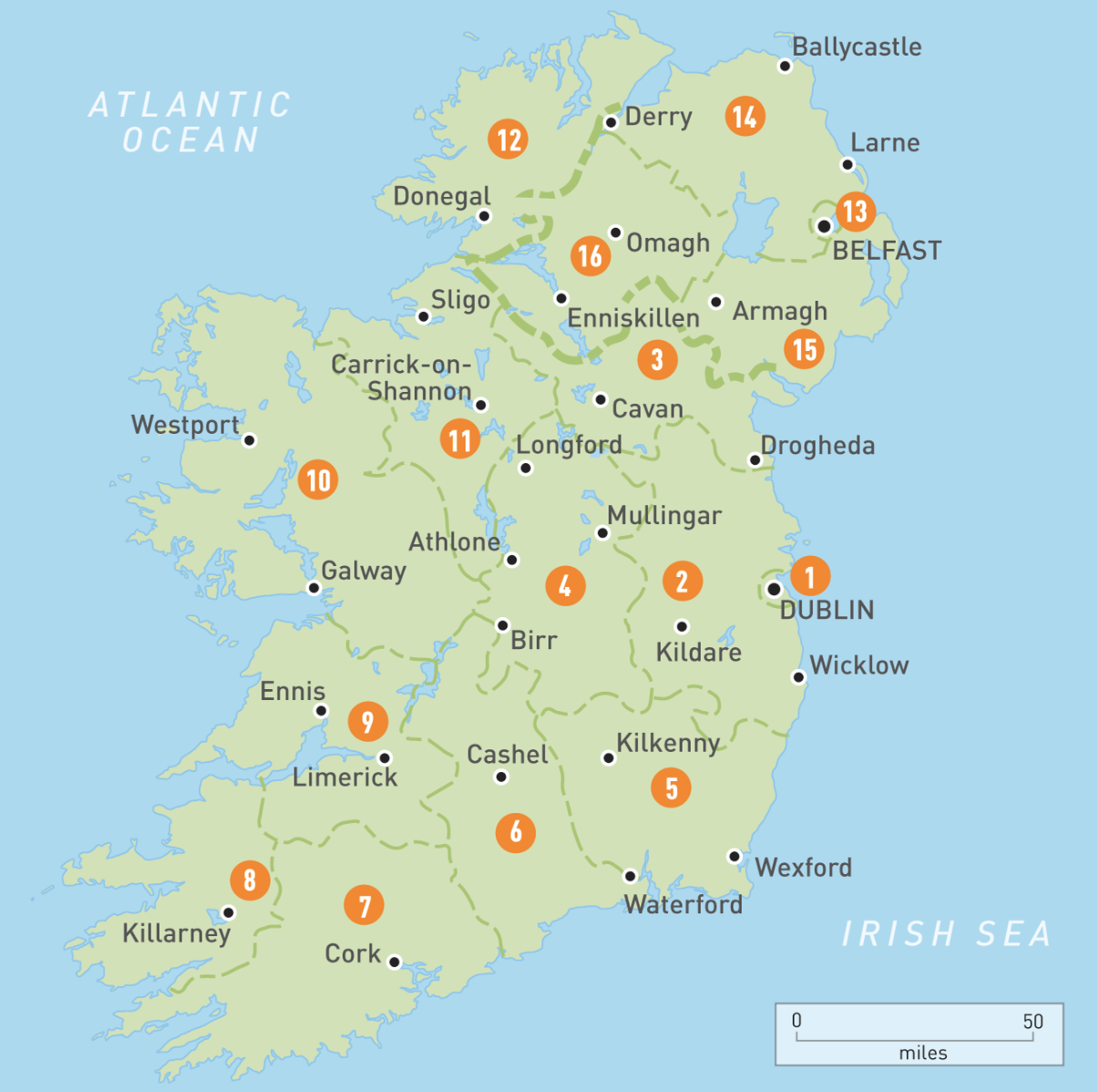
The Republic of Ireland is a small country in the eastern part of the North Atlantic and sits directly west of the United Kingdom. The entire island is only about the size of the state of Indiana and is home to just over 4 million people (Walsh, 2009). Its largest city and capital, Dublin, is on the eastern coast and is the location where the Easter Rising occurred.

Source: ontheworldmap.com
Source: roughguides.com
But, Why?
On September 18, 1914 the British granted The Irish Republic what they termed Home Rule. Through this agreement, Ireland was granted secure internal autonomy but remained under ownership of the British (Wallenfeldt, 2019). Shortly after its approval, the British found themselves in the midsts of World War I. Due to their involvement in the war, this plan was suspended before it was even implemented. Although some in Ireland felt that Home Rule would be successful, others saw it as another excuse for the British to deny Ireland its freedom (Easter Rising, 2019). From there a secret group began planning what they called the Easter Rising with the goal of gaining freedom from the British.
Want more information about Home Rule?
The Irish Republican Brotherhood
The Easter Rising began on Easter Monday, April 24, 1916 just around noon. This is the time when poet and rebel leader Patrick Pearse read aloud the Proclamation of the Irish Republic in front of Dublin’s General Post Office (The Easter Rising Begins in Dublin, 2019). This proclamation served as a promise for religious and civil liberty, equal rights, and equal opportunities for the citizens of Ireland (O’Leary, 2016). Most importantly, this proclamation was addressed to both Irishmen and Irishwomen alike. History tells us today that this inclusion of women in this address was an argument won by James Connolly and prominent feminist and socialist, Constance Markievicz, during discussions of what a free and just society would look like if independence from the British was gained (O’Leary, 2016). Patrick Pearse himself was a member of the Irish Republican Brotherhood, that although was established long before the Rising took place, can be credited with the planning of this event (What was the Easter Rising, n.d.).
Chronology of the Easter Rising and A blow-by-blow guide to the Easter Rising

The Proclamation of The Irish Republic.
Source: Wikipedia.com
Patrick Pearse
Source: Wikipedia.com
Within this brotherhood, a smaller group made up of seven men joined forces to plan out this rebellion (Easter Rising in 1916, 2015). They called themselves the Military Council and consisted of: Thomas Clarke, the eventual leader of the Irish Volunteers, Patrick Pearse, and the leader of the Irish Transport and General Workers Union James Connolly, in addition to others (Fighting for Independence, n.d.). Since the British were occupied with the breakout of the first World War, these men saw the opportunity to show their dissatisfaction with the way their country was being treated. They kept their intentions concealed from all outside sources, including the Supreme Council of the Irish Republican Brotherhood until right before the Rising was planned to occur (IRB, 2014). Originally, they had planned to take over several locations throughout Ireland but various setbacks including the British detection of a German ship carrying weapons for the battle forced them to focus primarily on the takeover of solely Dublin (Easter Rising, 2019).
The Brotherhood with the help of others including the nationalist organization of the Irish Volunteers, the Irish Citizens Army and women’s group Cumann na mBan and army of 1,600 was created and the rebellion began (Easter Rising, 2019). To carry out their plan, they captured and occupied many important buildings in Dublin including the General Post Office, the Four Courts, and the South Dublin Union (Dorney, 2011). They held these locations until Saturday the 29th of April when orders for surrender were made by Patrick Pearse to prevent any further death of non-combatants (Dorney, 2011).
At first, the British were made aware of the plan through intercepted telegrams from the Germans but refrained from action (McGreevy, 2016). They understood that the Irish were not content but felt that Home Rule was enough for the time with the war being everyone’s main focus (McGreevy, 2016). Once they realized that the Rising was actually occurring, it took them no time to take over due to the rebel’s lack of controlling the waterways in Dublin (McGreevy, 2016). Although the Rising took many lives, it was the catalyst for the Irish War of Independence and the beginning of the end for British Rule in Ireland (Easter Rising in 1916, 2015).
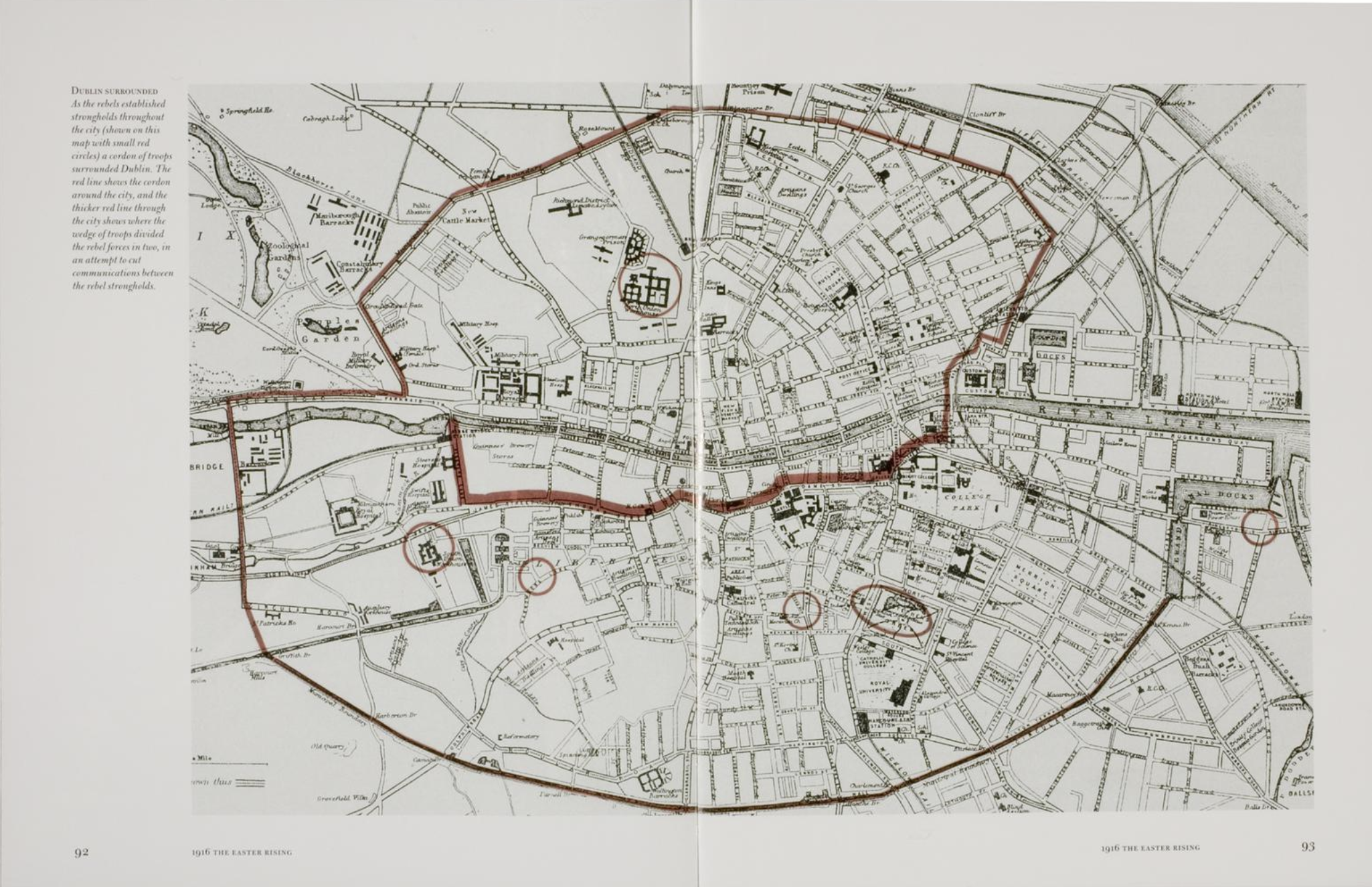
Source: National Library of Ireland
Changing Opinions
Although this was a win for the British in a military sense, they were about to lose a lot more. The British failed to look past the actions of the rebels and began to heavily punish them (Meagher, 2016). Obviously, the British had a negative view toward the Rising and expressed their anger through their actions after the Rising. The British began to imprisoned anyone who they felt was involved sentencing them to trial and some even death.

Source: Irelandbeforeyoudie.com
At first, the Ireland, and more specifically Dublin, citizens were enraged at their fellow people’s attack leaving their city a wreck. Overall, the rebellion destroyed 179 building and caused millions of dollars in damage (McNamara, 2002). It also put thousands out of their homes and jobs and resulted in 450 deaths of soldiers, police, and regular citizens while injuring over 2,000 others (McNamara, 2002). In addition, they were frustrated that British Soldiers were leaving World War I to aid in controlling the rebellion. This meant a greater risk for Irish natives who were recruited for the British cause over seas (Irish Public View, n.d.).
With these factors taken into consideration, it is obvious why these individuals saw the attack as harmful, disloyal, and even cowardly. Though, for some, these opinions changed when the British incorporated Marital Law and began their punishment post Rising (Irish Public View, n.d.). To do this they sent in Major General Sir John Maxwell who was so eager to impose the death penalty that he earned himself the name Bloody Maxwell (Irish Public View, n.d.).
Want to learn more about Maxwell?
Even with little evidence of specific individual’s involvement in the Rising, the death penalty sentences persisted, but Irish support did not (Hegarty & O’Toole, 2016). After the execution of James Connelly, who was to weak to even stand, most citizens began to realize that these individuals had Ireland’s best interest at heart (Irish Public View, n.d.). At this point, the catalyst that started Ireland’s trend towards independence was fully instilled and the British began to lose Ireland as a whole.
Today
As we fast forward through time, it has now been over 100 years since this event occurred. In 2016, the centenary celebration was held and it served as an important reminder for the citizens of Ireland. Although the memory brought about celebration, it also reiterated emotions surrounding the meanings and reasons for the attack. Discussion about its meaning occurred and individuals had extremely varying opinions. Some today believe that the individuals involved are no different from contemporary suicide bombers where others relate the events to faith (O’Driscoll). For others even, an unofficial contest for power was ignited. Many different groups, including the Irish Government, tried to claim their role as the true initiators of the Rising (O’Driscoll, 2017). Finally, other parts of the population have simply chosen to look past the events and accept them as the source of their independence.
Music
From the ending of the Rising and still today, music surrounding its events is written and sung. Much of this music portrays various feelings and has various purposes (Marjorie, 2016). Some of this music was even played during the celebration of the Rising bringing up emotion for the people listening.
Unlike some other countries, music in Ireland was not as very heavily censored. Since it was allowed, it was used for entertainment but also for many other reasons as well. In general, the music that was created surrounding these events has three styles: narrative, political, and loving or patriotic. Firstly, it was a way for individuals to make themselves feel better about what was going on. It acted as a form of consoling and allowed people to solace when they felt defeated (Marjorie, 2016). It also was inspiring, celebratory, and provided a sense of hope from horrible treatment or conditions they were subjected to or remembered (Marjorie, 2016).
The next category that this music could be classified into is narrative (Marjorie, 2016). This is the music that tells the stories of the events and the people of the Rising. Much like a living history book, it tells these stories from a first hand and intimate perspective letting the audience get as close as possible to the actual rebellion. Personally, I find this to be the largest grouping of music in regards to these events.
Finally, the last major category that this music could be categorized into is politics. For example one discussion about these works resulted in this comment, “… deliberately framed to provoke a political response or awaken some nationalist feeling” (Marjorie, 2016). This type of music was created with the goal to shake up outlooks and create support of political positions and actions. It was also used to express individual peoples view on issues that were occurring. Although this is seen more often in recent years, it is still one large subsection that much of this music falls into.
Overall, you cannot put all music in one distinctive category. Many of the music written about the Rising and this need for freedom crosses over two or even all three of these categories. Some songs may even be seen in a different context depending on who performing (for example in the different versions of The Ballad of James Connolly). In general though, music is extremely popular both for expressing emotion, documenting history, and for gaining political support all sparked by the massive influence that the Rising created. Still today, these songs are written, researched, sung, and enjoyed by vast populations all due to one groups desire for freedom.
A closer look at Ireland’s songs of rebellion
Conclusion
In conclusion, it can be inferred that the meaning of the Rising and the emotions surrounding it still are a sensitive topic for many. With this obvious factor at play, it is important to establish means to discuss feelings while preventing conflict. Since there is no way to go back and undo the violence while still gaining Ireland its freedom, citizens should be content with what they gained from it. These unsettled emotions can be expressed through means like music and art but should all focus on the main aim of healing from the hardships of this rebellion while still honoring the sacrifices made to obtain freedom.
References
- Editors, History.com. “The Easter Rising Begins in Dublin.” HISTORY, 20 February 2019, https://www.history.com/topics/british-history/easter-rising.
- Editors, History.com. “Easter Rising.” HISTORY, 25 January 2019, https://www.history.com/topics/british-history/easter-rising
- Donald McNamara. “Bloody Instructions: General John Maxwell in Dublin after the Easter Rising.” The Princeton University Library Chronicle, vol. 63, no. 3, 2002, pp. 534–558. JSTOR, http://www.jstor.org/stable/10.25290/prinunivlibrchro.63.3.0534.
- Dorney, John. “The Easter Rising – A brief overview.” The Irish Story, 22 April 2011, http://www.theirishstory.com/2011/04/22/the-easter-rising-%E2%80%93-a-brief-overvi w/#.XGyEyc9Ki2w.
- “Easter Rising in 1916.” Septs of Ireland, 28 April 2015, http://www.easter1916.net/.
- Hegarty, Shane & O’Toole, Fintan. “Easter Rising 1916 – the aftermath: arrests and executions.” Irish Times, 24 March 2016, https://www.irishtimes.com/culture/heritage/easter-rising- 1916-the-aftermath-arrests -and-executions-1.2583019.
- Marjorie, Brennan. “Ireland’s songs of rebellion.” Irish Examiner, 25 March 2016, https://www.irishexaminer.com/lifestyle/artsfilmtv/irelands-songs-of-rebellion-389291.ml.
- McGreevy, Ronan. “How the British ‘lost’ the Easter Rising.” Irish Times, 19 March 2016, https://www.irishtimes.com/news/ireland/irish-news/how-the-british-lost-the-easter-rising-1.2579169.
- Meagher, Kevin. “What should Britain feel about the Rising? How about shame?” Independent, 26 March 2016, https://www.independent.co.uk/voices/what-should-britain-feel-about-t he-easter-rising-how-about-shame-a6954251.html.
- O’Driscoll, Cian. “Knowing and Forgetting the Easter 1916 Rising.” Australian Journal of Politics & History, vol. 63, no. 3, Sept. 2017, pp. 419–429. EBSCOhost, doi:10.1111/ajph.12371.
- O’Leary, Olivia. “Why, 100 years after the Easter Rising, are Irish women still fighting?” The Guardian, 25 March 2016, https://www.theguardian.com/commentisfree/2016/mar/25/100-years-after-easter-rising-irish-women-still-fighting-gender-equality.
- “The Irish Republican Brotherhood (IRB).” British Broadcasting Corporation, 24 September 2014, https://www.bbc.co.uk/history/british/easterrising/profiles/po17.shtml.
- Wallenfeldt, Jeff. “Home Rule.” Encyclopaedia of Britannica, 2019, https://www.britannica.com/event/Home-Rule-Great-Britain-and-Ireland.
- Walsh, Dennis. “The Relative Size of Ireland.” Roots Web, 2009, http://sites.rootsweb.com/~irlkik/ihm/rel_size.htm.
- “What was the Easter Rising?” Century Ireland, https://www.rte.ie/centuryireland/index.php/articles/what-was-the-easter-rising.
 Human Rights, Music, & Resistance