
This project is a part of a research done during the International Human Rights, Music & Resistance course. My project focused on the issue of suppressing of human rights in Russia by the authoritarian state represented by president Putin. It follows the case of Pussy Riot’s protest against the shrinking of freedom of speech, political rights, and rights of the LGBT community as well as women. The perspective of the project on the issue is that Pussy Riot represented the resistance to the authorities and expressed the criticism through their music. The group had, indisputably, right to do that as everyone should be enabled to express opinions. The project will consider the Pussy Riot’s form of resistance and the stance of the state (President Putin) and the Russian Orthodox Church as they are opposed to Pussy Riot’s action and try to silence them. On the contrary, the project discusses the stances of an international audience and international organizations like those who support and encourage Pussy Riot’s actions. As a last stakeholder, the paper will discuss a stance of the Russian public and the democratic opposition which is more inclined to be negative.
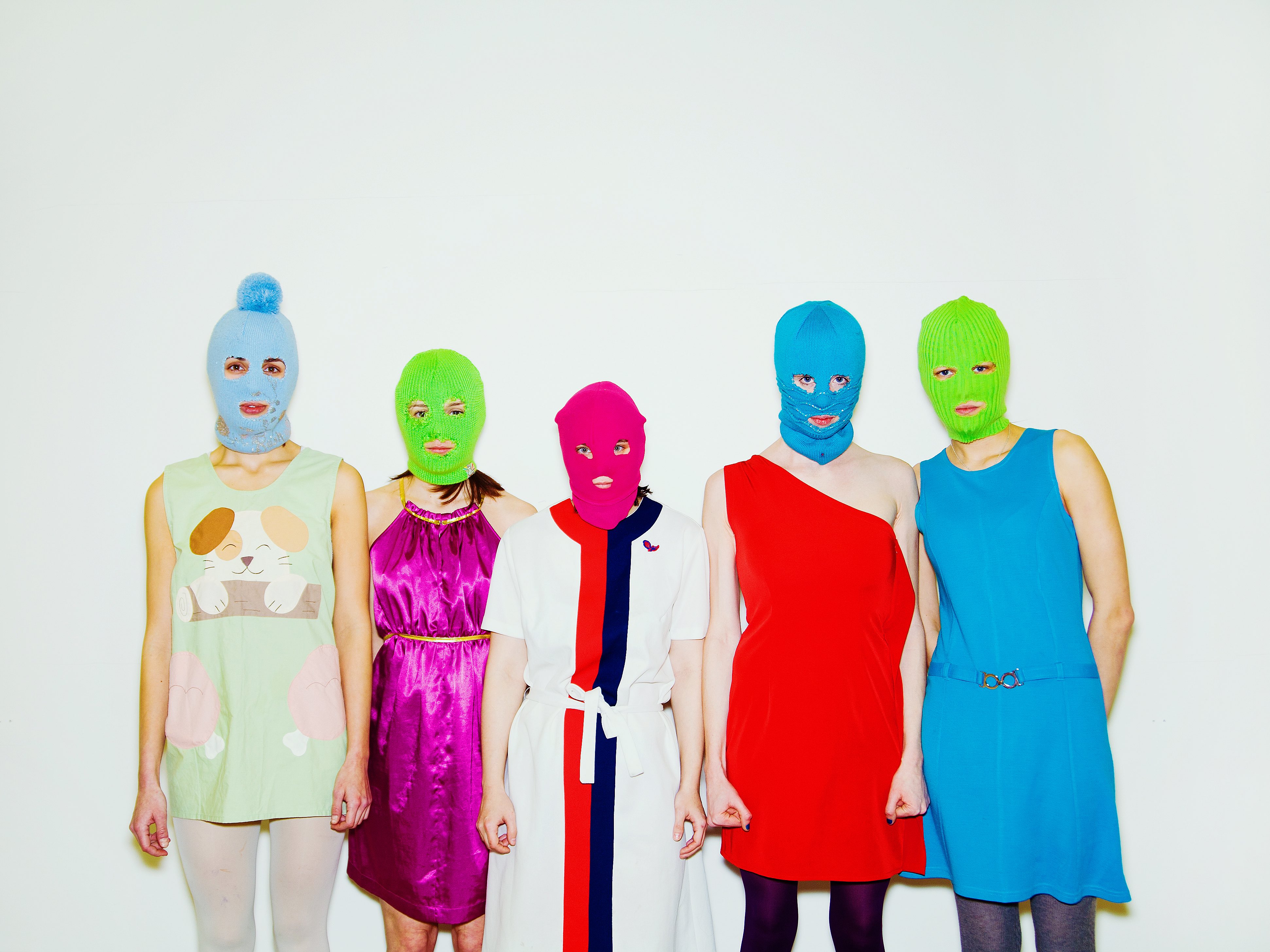
Source: vmagazine.com
Pussy Riot, a feminist punk-rock group, emerged in 2011 after Russia’s president Vladimir Putin announced he would run for a third presidential term. By that time Putin was in power for eight years and de facto in power for another four when being the prime minister of Dmitry Medvedev’s presidency. The expected winning would (and eventually did) enable Putin to stay in power for another six years. The reason why this was a concern not only for Pussy Riot is that the Putin’s regime is authoritarian, closely tied with the Orthodox Church and suppressing human, civil and political rights.
The group gained global recognition after a performance in Moscow’s Cathedral of Christ the Savior which they held on February 21, 2012. They performed “Mother of God, Chase Putin Away” to create a video clip for the song dressed in bright colors and wearing balaclavas.
The performance provoked a scandal in Russia. The group was accused of violation of public order and a criminal case was opened against the Pussy Riot’s members leading to arrests. The prosecutor demanded extreme punishments such as three years in a labor camp. The prosecution was fully focused on the pretense that the arrest was based on the issue is one of faith, indeed spreading of religious hatred. The fact that their performance was more about drawing attention on issues of politics, was entirely ignored by the judiciary. Some even say the prosecution of Pussy Riot did have a lot in common with the Soviet dissident’s trials decades ago. Prior to this most famous performance, Pussy Riot had been able to perform several times without being sanctioned of persecuted. But this time the Russian government responded with unprecedented and unexpected determination to punish this small group of activists.
The stance of the Russian state: The harsh reaction of the state to Pussy Riot’s performance has to be considered in the context of the situation then. Since the beginning of his rule, Putin positioned himself as a tough guardian of the Russian state, its interests, borders and overall position in the world. He fought against the oligarchs and region’s governors who usurped power. He also defended Russia against the Western influence and the society against the spread of unwanted democratic revolution that appeared in the region. Putin’s rule was, since the beginning, complemented by economic growth that was only partly a result of Putin’s policies but more of a result of high oil prices. Nevertheless, Putin was able to secure the support of a broad majority of Russian society. First troubles of Putin’s regime appeared in the years of 2011-2012. Widespread anti-regime protests emerged in 2011-2012 and more than any other event shook the stability of the regime and put Putin on the defensive. Russia witnessed the protests after the fraudulent Parliamentary and Presidential election that resulted in the re-election of Putin as President for a third term. Pussy Riot’s act falls within the context of opposition activity and it is arguably the one that caught most of the international attention.
The Russian state responded with unprecedented harshness as mentioned above. Pussy Riot’s punishment represents a silencing of opposition engaging in freedom of artistic expression. Their case served as a show trial with disproportionate sentences to set a deterrent example to discourage other members of the opposition movement to continue with the protests. In doing so, the regime completely ignored Pussy Riot’s political message and framed the act into the issue of morality and religious hatred.
The stance of the Russian Orthodox Church: The venue for Pussy Riot’s performance was not chosen by accident. Although according to Article 14 of the Russian Constitution Russia is a secular state, the Russian Orthodox Church has a very strong position. Russian people are obliged to be part of it as proof of allegiance to the state. Putin and the head of the Russian Orthodox Church, the Patriarch Kirill of Moscow, serve as each other’s bulwarks of legitimacy. Therefore, Pussy Riot protested against the Church’s support for Putin’s re-election. The Church took the performance as an assault on the institution. The institution that strengthens the state’s ideology and serves as the state’s strategic partner. Thus, the Patriarch Kirill denounced the performance as sacrilege.
The stance of the Russian public and Russian democratic opposition: In general, Russia is a conservative, fairly nationalistic, middle-income nation with underdeveloped political culture carrying a huge heritage of the communist past. That is why Russians are not exactly fans of dissent punk music in the context of protest. Pussy Riot’s punk prayer in the Cathedral got very complicated reception among both religious and secular Russian audiences as well. What is more, unlike many Western democratic countries, Russia never embraced the notion of natural human rights. What Russian state grants are only rights specified by positive law, meaning individuals have no rights as persons but only as citizens. The criminalization of Pussy Riot performers triggered mixed feeling across the country but in general, people were more inclined to support the state’s decision to punish the members of Pussy Riot. Therefore, only ten percent of respondents in a poll opposed any sort of criminal punishment and more than 47 % considered the seven-year jail term appropriate. The opposition itself cannot hope for much support from the quiet majority of people that lives outside the biggest cities of Moscow and St. Petersburg. And even among members of the arts community, the response to the performance was negative. From the democratic opposition, it was only Alexei Navalny who stood by Pussy Riot. Thus, even among those who claim to be democratic, it is still hard to accept the perpetuation of patriarchal attitudes towards women.
The stance of the international community and international organizations: As opposed to the domestic audience, the reaction to the Pussy Riot’s performance was supportive of their cause. The West and especially the EU criticized Russia for the harsh punishment. Amnesty International called for their release. Human Rights Watch questioned the rightness of the detention. Western media also neglected that the performance would have any religious context. The case has, indeed, renewed international attention on human right in Russia. It also can be seen as an example of how women engaged in political activism in public are seen as deviants.
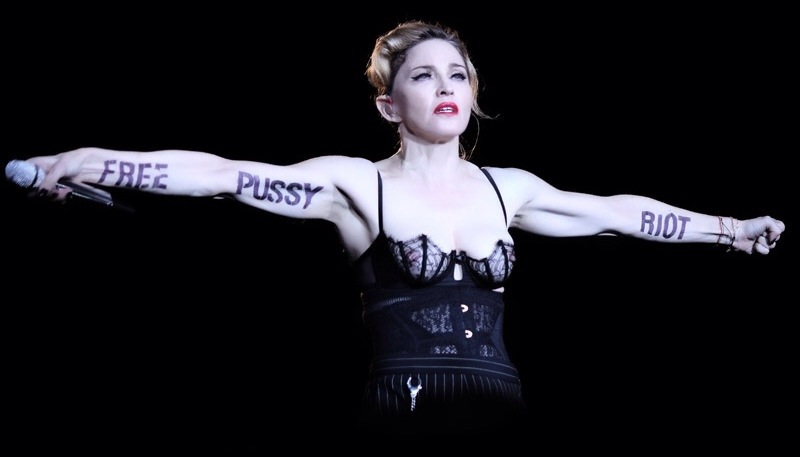
Pussy Riot members, according to international human rights, have the right to perform whatever genre they like, dressed as they prefer and should be allowed to criticize the regime. It is more than obvious that in the contemporary authoritarian political climate and anti-western approach of the state, it is very hard to start a conversation about human rights. What is more, it is a very dangerous environment for human rights activists as we can see with the example of imprisonment of Pussy Riot. In the past we witnessed murders of many investigative journalists or opposition leaders such as Anna Politkovskaya or Boris Nemtsov, just to name the most famous cases.
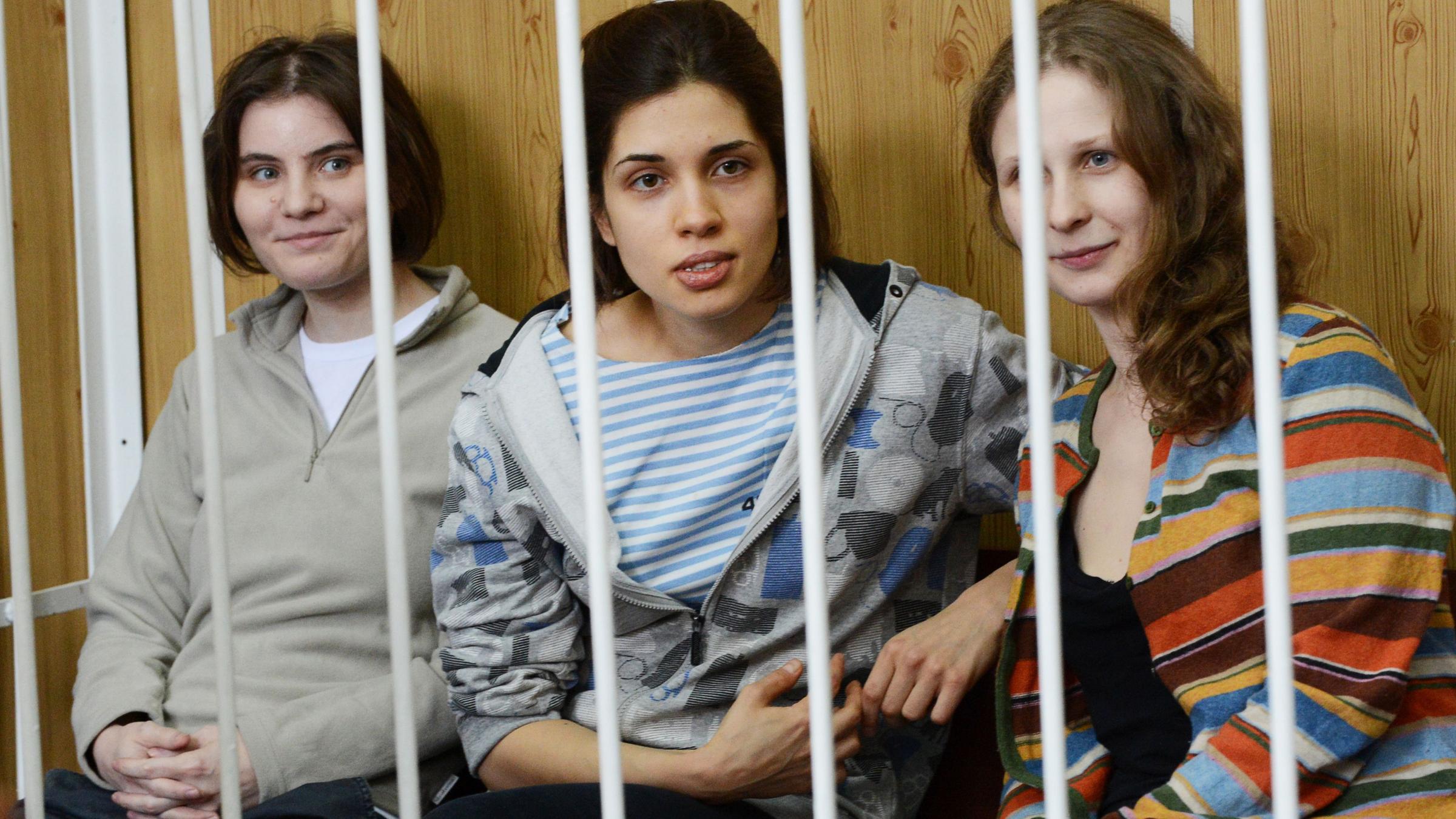
Source: thetimes.co.uk
Unfortunately, there was a little prospect for the Pussy Riot’s case to be used to enhance human rights, and by now we know that it did not work out. Quite opposite, they offered the conservative state forces an ideal case allowing them to equate their political protest including the fight for gender equality and campaigns for LGBT rights, with religious hatred and destabilizing the nation. The main Russian political party, supporting the president, has also launched a campaign against activists fighting for human rights, promoting local laws around the country to punish ‘pro-homosexual propaganda’ that later on became federal law. Furthermore, various laws considering ‘morality’ were accepted such as a ban on cursing or proposed tax on divorce.
In Russia, there are few if any means to publicly mobilize opposition which would challenge the current regime that suppresses political, civil, and human rights. The significance of Pussy Riot’s protest is mainly socio-political and cultural. They introduced a new nature of political protest that raised above the traditional forms of opposition and civic dissent, such as ineffective street rallies or forming of opposition political parties that are systematically prevented from participating in political life. The novelty of Pussy Riot’s protest is also incorporating social media and the internet to spread their message and gain attention and recognition of people. Thanks to that they were able to reach out to a mass audience abroad and to some extent also in Russia. Furthermore, their performances were first of a kind in Russia and proposed new social order based on challenging the stereotypes.
What is more, Pussy Riot’s protests emerged in the light of popular upheaval in 2011-2012 and still continue untill today in one form or another. Since the start of Putin’s third presidential term in 2012, more than 50 laws that does not fit into any demoractic agenda have entered into force. Some of them directly violate basic human rights. Just to name some of them: ‘Law on gay propaganda‘ that does not respect the rights of LGBTQ+ community and basically bans even public mention about homosexuality; ‘Law on insulting religious feelings‘ which criminalizes other religious expressions and opinions which contradict the so-called ‘traditional Russian culture’ or ‘Anti-protest law‘ that criminalizes a particioation in an unsanctioned rally or protests, this law clearly violates the freedom of assembly; and many more . Thus, the situation in Russia is not getting any better in terms of respecting human rights or freedoms. Nowadays, they ahve became more of a activits than a music group.
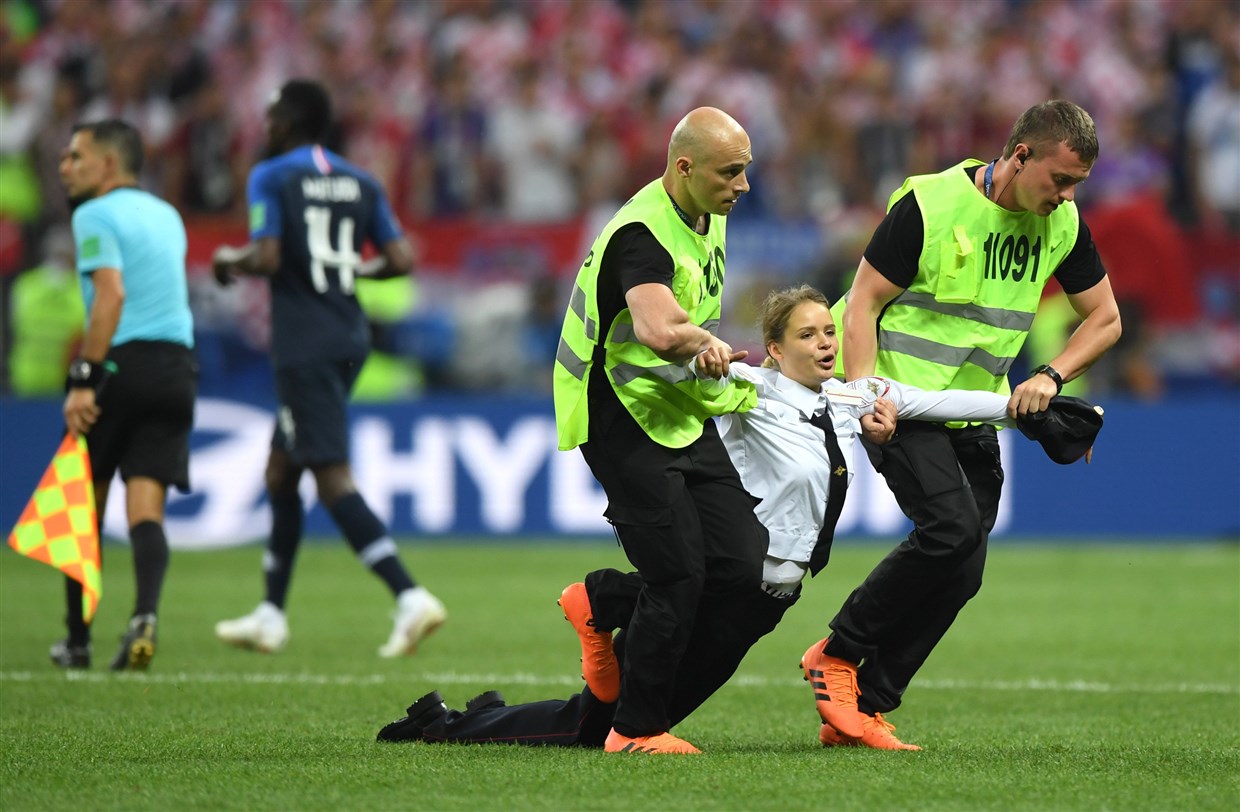
The latest performance: Pussy Riot disrupting the World Cup finals in Moscow. It was a statement to support the release of political prisoners. July, 2018
Source: nbcnews.com
The only possible solution for the embracing of human rights in Russia is the pressure from the international community and international organizations. Lately, even NGOs originating abroad started to be labeled as ‘undesirable’ in Russia. Thus, there is little space for Russian citizens to act upon and fight for human rights. Those who can help are members of the international community by pressing on their governments and international organizations to hold Russian state accountable by sanctions or whatever means necessary. We, as the members of the international community, can pressure our own governments to not to cooperate with Russia and make a clear statement denouncing its abuse of human rights.
Sources:
Dmitriev, Mikhail, and Daniel Treisman. “The Other Russia: Discontent Grows in the Hinterlands.” Foreign Affairs, 91(5).
Human Rights Watch. 2018. Russia: Events of 2018. https://www.hrw.org/world-report/2019/country-chapters/russia
Lipman, Masha. 2012. “The Absurd and Outrageous Trial of Pussy Riot.” The New Yorker. https://www.newyorker.com/news/news-desk/the-absurd-and-outrageous-trial-of-pussy-riot
Miller, Andrew. 2012. “Perfect opposition: On Putin and Pussy Riot.” Public Policy Research,19. DOI: 10.1111/j.1744-540X.2012.00709.x.
Pussy Riot. 2012. “Mother of God, Chase Putin Away.” Youtube.com(online). https://www.youtube.com/watch?v=lPDkJbTQRCY
Rourke, Brian, and Andrew Wiget. 2014. “Pussy Riot, Putin and the Politics of Embodiment.” Cultural Studies. DOI: 10.1080/09502386.2014.974644
Sharafutdinova, Gulnaz. 2014. “The Pussy Riot affair and Putin’s démarche from sovereign democracy to sovereign morality.” Nationalities Papers: The Journal of Nationalism and Ethnicity, 42(4): 615-621. DOI: 10.1080/00905992.2014.917075
Turbine, Vikki. 2013. “What Does the Pussy Riot Case Tell Us about the Status of Women’s Human Rights in Russia?”e-International Relations.
Woodyard, Kerith M. 2014. “Pussy Riot and the Holy Foolishness of Punk”. Rock Music Studies, 1(3): 268-286. DOI: 10.1080/19401159.2014.949555
Zabyelina, Yuliya, and Roman Ivashkiv. 2017. “Pussy Riot and the Politics of Resistance in Contemporary Russia.” Oxford Research Encyclopedia of Criminology.http://oxfordre.com/criminology/view/10.1093/acrefore/9780190264079.001.0001/acrefore-9780190264079-e-208.
 Human Rights, Music, & Resistance