
My research issue addresses an anti-war perspective during the Vietnam War. A lot of people from around the world during the Vietnam War were against the idea of it. Countries that were barely involved even expressed a negative opinion on the matter. The United Kingdom was one of those top countries.
What was the Vietnam War?
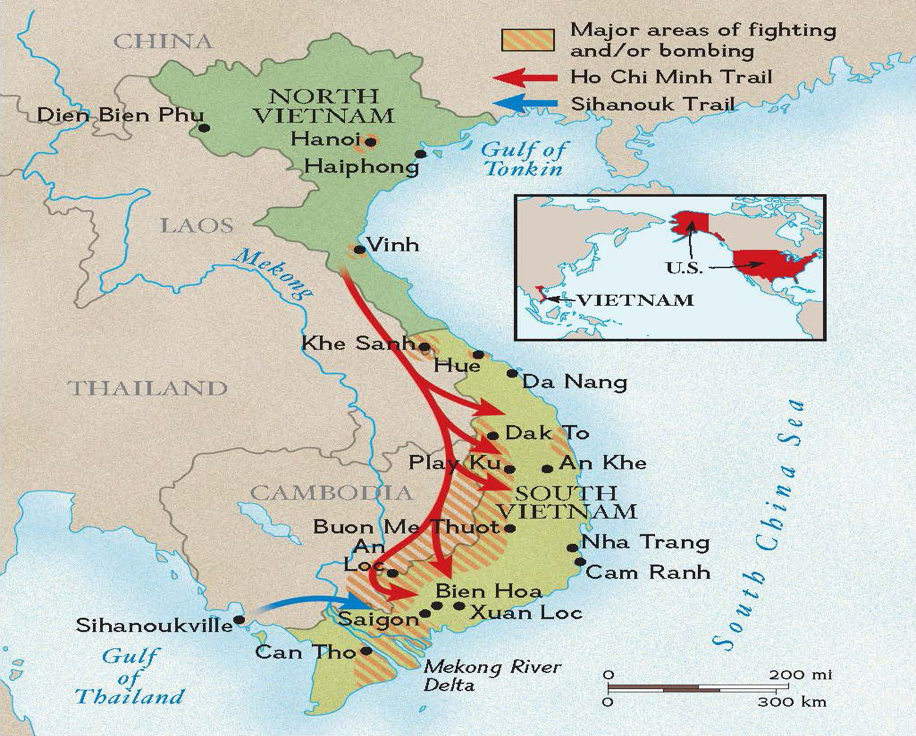
The Vietnam War was a battle between North Vietnam (a communist political system) and South Vietnam along with its ally the United States of America. The gruesome war went on from 1955-1975 (20 years) and caused over 3 million causalities. Most of the battling during the war took place in South Vietnam as shown in the map below. As time went on, Americans became very unpleased with the war and the end grew near in 1973 when President Nixon commanded all U.S. troops to withdrawal from South Vietnam. North Vietnam took over within the next two years and the war war finished, with the end result being North and South Vietnam combining into the Socialist Republic of Vietnam. https://www.history.com/topics/vietnam-war/vietnam-war-history
Britain’s Involvement
Since the United States and Britain are allies, according to the “Power of Proxy” agreement shortly before the Vietnam War started, Britain formed a group called BRIAM that consisted of trained civilians that were ready to fight on command upon requested of South Vietnam’s president (“The United Kingdom Involvement in the Vietnam War”). BRIAM was trained by a South Vietnamese leader who specialized in guerrilla warfare. Although BRIAM never went into a physical violent action, the idea of civilians being ready to fight in this war was not a popular opinion. Multiple bands from the United Kingdom expressed their disapproval about the Vietnam War. They wrote songs defending peace to try and reach an audience that would agree with their message and take action to prevent the war from continuing while trying to prevent Britain from getting involved. Therefore, for my research project, I have examined four important songs that were influential in the Vietnam War area that were composed by British rock bands. I wonder how many people were touched by this music in the time period and if the artists music actually made an impact on the war.
What groups in the United Kingdom wrote music in disapproval of the Vietnam War?
Four groups during the Vietnam War were extremely vocal about their disapproval of the war. These four interest groups all involve rock and roll bands from the United Kingdom. The first was the Rolling Stones, which was one of the most well-known rock bands in history. The second interest group was John Lennon who was known as an artist that spoke up about any violent act and tried to promote peace. He did not stray from this forté when he spoke up about the Vietnam War. The third social interest group was The Animals. They were not as popular as the other social groups, but their anti-war song about Vietnam quickly gained them some popularity throughout Britain and the world. The fourth social group is the popular band The Beatles. While John Lennon was a part of this group for a while, they whole group agreed with his peaceful views and decided to sing to the public about their opposition against the Vietnam War.
“Gimme Shelter” by The Rolling Stones
The Rolling Stones were an extremely popular band in Britain. They hit their peak in 1960 which was five years after the Vietnam War began. The Rolling Stones members included Brian Jones, Mick Jagger, Keith Richards, Bill Wyman, Charlie Watts, and Ian Stewart. When Brian Jones was kicked out of the band and died less than a month later, a new member named Mick Taylor (“Rolling Stones Biography”) joined the band. As people started to wonder if this band would still be the same without band member Brian Jones, in 1969 they wrote the song “Gimme Shelter” which sparked a lot of attention from around the world. The Rolling Stones now were expressing political issues that created a bigger name for the band. The haunting tone was written to try and warn the American public about the dangers that would come from their involvement in the war (“Gimme Shelter”). “Oh, a storm is threat’ning/My very life today/If I don’t get some shelter/Oh yeah, I’m gonna fade away”. This first verse captures the listeners attention quickly and warns them that if they do not disengage themselves from the violence, people will die. The one line that is apparent in almost every verse is “It’s just a shot away”. This powerful line and use of repetition is a tactic used to try and scare the listener out of war. This whole song is about death that can arise from this war. The Rolling Stones tried to use death as center point to scare citizens into trying to agree on a ground of peace. https://www.youtube.com/watch?v=RbmS3tQJ7Os
“Happy Xmas (War Is Over)” by John Lennon and Yoko Ono
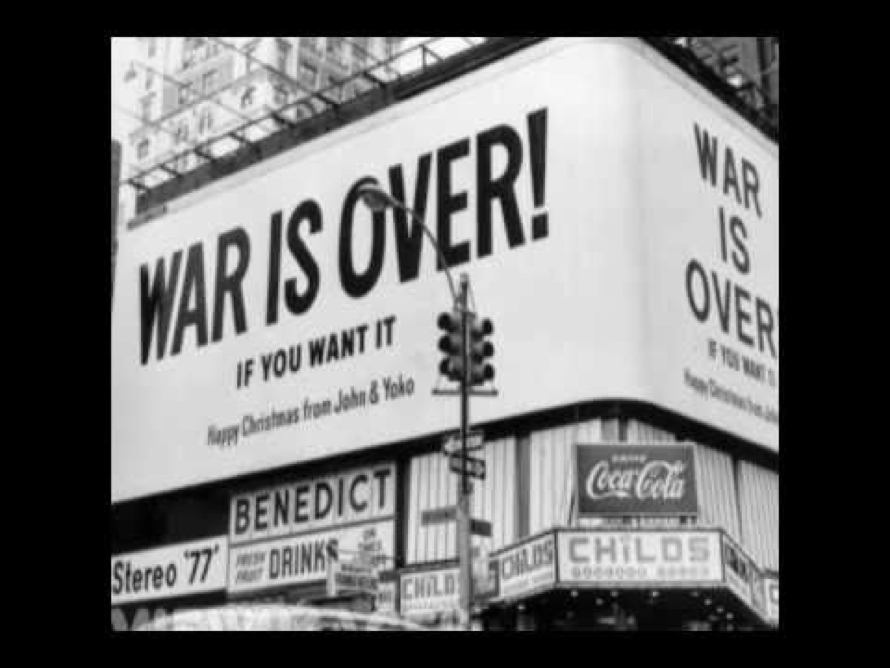
John Lennon used a completely different tactic in his song. He was a man who was very centered around the world being at peace. Therefore, it is no surprise he was against the Vietnam War. Lennon was a member of the popular band The Beatles, but after the broke up, he still was on a mission to get his voice heard. In 1969, him and his wife Yoko Ono released a Christmas hit. The whole purpose of his song was to try and reach an American audience because he wanted to warn them to stay out of the war. Major cities in the United States rented out billboards with the song title and it became a huge hit in America. Along with the song title, he decided to add the saying “if you want it to be” right next to this. I believe he added in this extra piece to try and use a tactic that would leave a choice for the listener. If the listener heard the song and then was left off with this extra piece, they would realize that what Lennon was portraying was an opinion and it could be changed if there was enough will to do so. His approach to change was a completely different tactic than The Rolling Stones and it seemed to work out pretty well. Although it was only a hit in America because the United Kingdom would not release the song right away due to “publishing rights”, the message was still strong. Almost so strong that some could say that Britain was so hesitant to release it because of how it could be viewed and could cause people to start an uprising. https://www.youtube.com/watch?v=z8Vfp48laS8
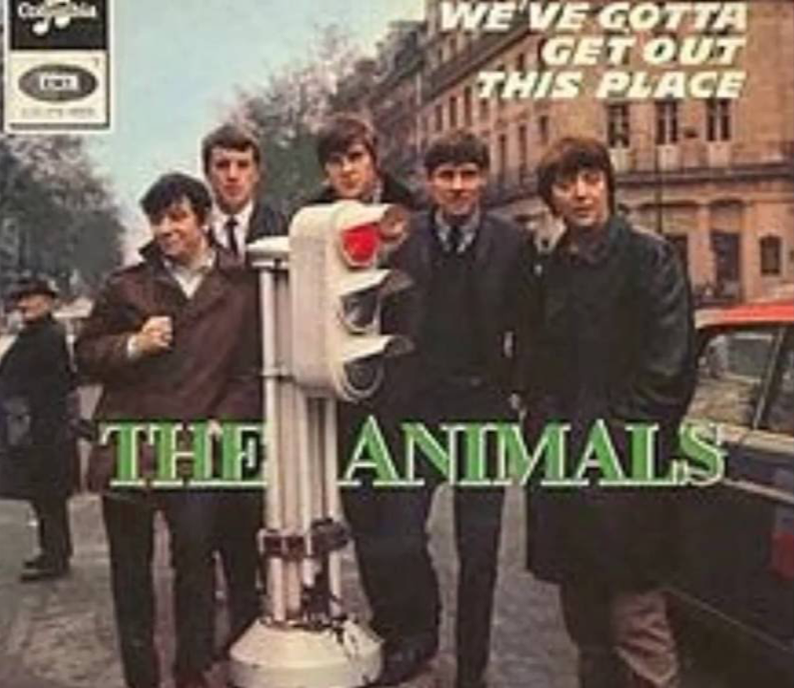
“We Gotta Get Out of This Place” by The Animals
A rock band titled The Animals released a hit in 1965, ten years after the war started. 1967 was also the year America stacked up troops in South Vietnam and starting bombing North Vietnam (Eames). The song title “We Gotta Get out of This Place” was perfect for this setting. The lyrics of the song focus on how the soldiers have to get out of the war or they will die. Since Americans just went into battle, The Animals directed this song to the American public to try and warn them about the horrors that would now arise since they stacked their troops in South Vietnam. The lyrics “And one thing I know is true/You’ll be dead before your time is due” is an important lyric in this piece to prove the point that death is the only thing that will arise from this war. The Animals used the same scaring tactic as The Rolling Stones did, and it seemed to work out pretty well for their ratings. https://www.youtube.com/watch?v=wJVpihgwE18
“Revolution” by The Beatles
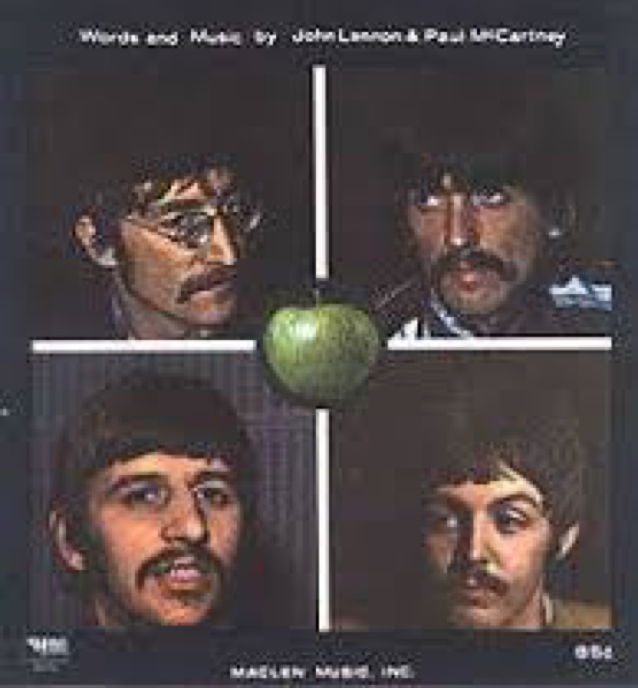
The last British rock group that opposed to Vietnam War and expressed that opinion through music was The Beatles. The Beatles were a popular British rock band during the 1900’s. They created songs that caught the ears of multiple people, so when they wrote the song Revolution, their first anti-war (anti-war in Vietnam) song, it sparked a lot of attention. John Lennon, the lead figure of the group, wrote the song because even though he thinks God will save them from war, he still wants to get the message across to try and end the violence (Songfacts). An important lyric in the catchy tune of “Revolution” is “But when you talk about destruction/Don’t you know that you can count me out”. This is saying that when there is a destructive force (the fighting in the war), he wants no take in it. While he is saying that he wants no take, he is making the listeners feel like they would want no take in the violence either. This is a persuasive tactic that made people really think about how they wanted to perceive the war. The title of the song also has some irony in itself. When people hear of the word “revolution”, people automatically associate violence towards it. The word revolution, in this sense, is actually trying to promote peace and start a fight towards the end of not only the Vietnam War, but war in general. https://www.youtube.com/watch?v=AFckPkukF7g
Social Groups that favored the War
Although it seemed that the Vietnam War was opposed by many artists, some song writers came back and expressed their favoritism for the battle. (Anti-War and Pro-War Songs About Vietnam). The song “Hello Vietnam” recorded by Johnnie Wright in 1987 was a number one hit in the United States and lingered on the charts for about a month after. The persuading tactic that made this song so popular was patriotism. America has been fighting this war for so long now and the artist is trying to let the public understand why we are still fighting. “We must stop communism in that land/Or freedom will start slipping through our hands/”. The first line is the most influential because the majority of America did not agree with the idea of communism. This song helped sway people into favor of the war because of the amount of patriotism in the song. https://www.youtube.com/watch?v=ZQDH_2IKaE4
Kent State Incident
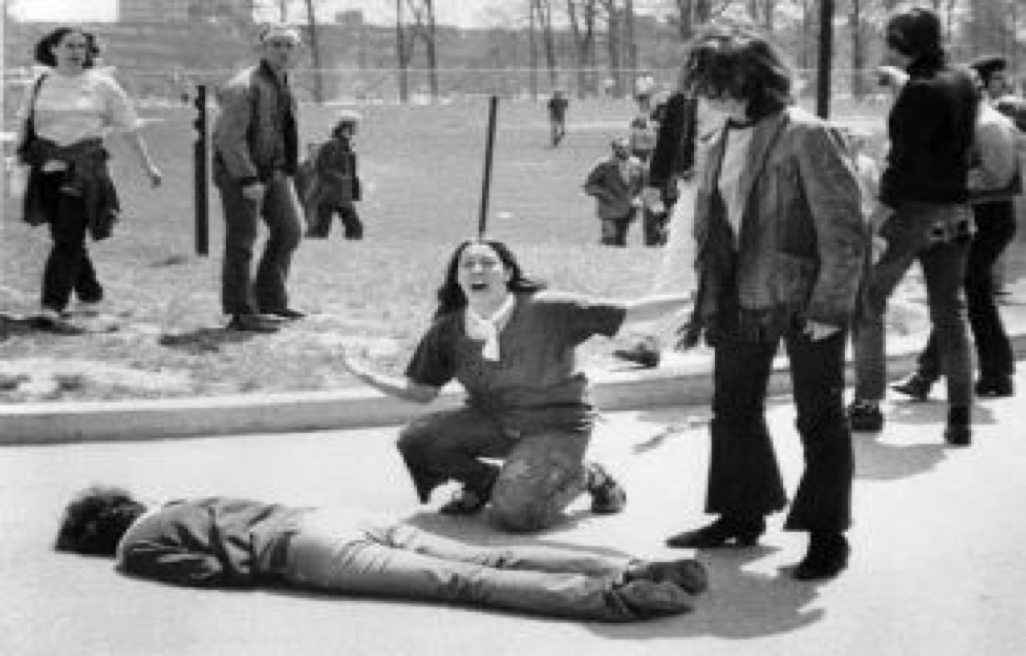
As you can see by these four British Rock bands, the United Kingdom was also divided on whether they wanted the Vietnam War to take place or not. The United States disapproval for the war was so strong that there was an incident at Kent State that caused havoc around the United States and world. On Kent State campus during the Vietnam War, students were having a march against the Vietnam War. Things quickly turned ugly as four students were shot and killed by police authorities. A documentary about the incident is linked underneath this paragraph with further interpretation and details about the horrifying incident. Although there was not an out burst of disapproval as strong as the United States, the negative feelings towards the war were still there in the United Kingdom. https://www.youtube.com/watch?v=vVNUIOUIMeo
The Town Hall
The Town Hall was an eye opening experience that helped me expand and think more critically on my subject. I was able to connect these songs to common themes in my class, including human rights and censorship. I also gained a better connection to the people in my group and what subjects they were focused on. All of our subjects were connected by music or the arts in some way. Our subjects ranged from the hurricane in Haiti to police brutality. Without this Town Hall, I would have thought that my assignment had no deeper meaning or underlying important theme.
Conclusion
Citizens in the United Kingdom, after analyzing and listening to these songs, should be uneasy. They most likely felt a sort of panic that the war was getting out of hand, too violent, and could cause death around the globe, especially since BRIAM could shortly get involved. Because of these feelings of panic and anxiety, citizens could come together and protest against the war. They could have marches or rallies against the idea of BRIAM becoming a group which could lead to the military group to potentially breaking up. Multiple actions could be taken, but the most important one would be for the citizens to contact two social interest groups. The first would be the artists of the song since they have a bigger platform than un-famous citizens. They citizens and artists could then work together to try and gain a solution to the problem of war. The strength in numbers would be hard to beat. The second social interest group would be the government. Once the angered citizens and outspoken artists went for the government, their voices would be heard and change for peace would not feel so far away.
Works Cited
“Anti-War and Pro-War Songs about Vietnam – Page 2 of 2.” The Vietnam War,
https://thevietnamwar.info/anti-war-pro-war-songs-vietnam/2/?vietnam-war-media=anti-war-pro-war-songs-vietnam
Eames, Tom. “The Story of… ‘Happy Xmas (War Is Over)’ by John Lennon.” Smooth, Smooth,
11 Dec. 2018, http://www.smoothradio.com/features/the-story-of/john-lennon-happy-xmas-war-is-over-lyrics-meaning.
Editors, History.com. “Vietnam War.” History.com, A&E Television Networks, 29 Oct. 2009,
http://www.history.com/topics/vietnam-war/vietnam-war-history.
“Gimme Shelter.” Vietnam’s Anti-War Movement,
https://vietnamsantiwarmovementintheus.weebly.com/gimme-shelter.html
Hopkins, and Alexander E. “Protest and Rock n’ Roll During the Vietnam War.” Inquiries
Journal, Inquiries Journal, 1 Nov. 2012, http://www.inquiriesjournal.com/articles/713/protest-and-rock-n-roll-during-the-vietnam-war.
“Rolling Stones Biography.” Encyclopedia of World Biography,
https://www.notablebiographies.com/Ro-Sc/Rolling-Stones.html
Songfacts. “Revolution by The Beatles.” Song Meanings at Songfacts,
http://www.songfacts.com/facts/the-beatles/revolution.
“The Twenty Best Vietnam Protest Songs.” Council on Foreign Relations, Council on Foreign
Relations, https://www.cfr.org/blog/twenty-best-vietnam-protest-songs
“The United Kingdom Involvement in the Vietnam War.” The Vietnam War,
https://thevietnamwar.info/united-kingdom-involvement-vietnam-war/
 Human Rights, Music, & Resistance